Be the first to get exclusive No Deposit bonuses and WOW casino promotions! Get access to our new online casinos, top stories and special iGaming events for FREE.
Be the first to get exclusive No Deposit bonuses and WOW casino promotions! Get access to our new online casinos, top stories and special iGaming events for FREE.
Be the first to get exclusive No Deposit bonuses and WOW casino promotions! Get access to our new online casinos, top stories and special iGaming events for FREE.
Be the first to get exclusive No Deposit bonuses and WOW casino promotions! Get access to our new online casinos, top stories and special iGaming events for FREE.
Be the first to get exclusive No Deposit bonuses and WOW casino promotions! Get access to our new online casinos, top stories and special iGaming events for FREE.
Be the first to get exclusive No Deposit bonuses and WOW casino promotions! Get access to our new online casinos, top stories and special iGaming events for FREE.
Be the first to get exclusive No Deposit bonuses and WOW casino promotions! Get access to our new online casinos, top stories and special iGaming events for FREE.
Hi, I'm Deni! I'm a research obsessive with a passion for gambling regulations, market trends, and casino news. I dig deep into every topic I cover - so every article, review, or guide I write is built on solid research and real detail.
Prediction markets no longer sit outside iGaming, as operators are adopting them and Gen Z is gravitating toward them. Only regulators are left to catch up. Here's what's changing for
Prediction markets are no longer sitting outside online gambling. Operators are absorbing them, regulators are scrambling to classify them, and they show up as a competing attention system. But younger players are already leaning into them without waiting for traditional gambling platforms to catch up.
Prices move in real time. Events range from elections to crypto to global news. There are no spins or static odds, just shifting probabilities shaped by crowd behaviour.
The big question is not whether prediction markets matter. It is how fast they are moving into iGaming and what that means for how the entire industry is regulated and approached.
CasinoWow explores the topic in depth by investigating the influence of prediction markets on casinos and why Gen Z is ahead of all other players. We also spoke with experts from Rooster.bet Casino and the Malta Gaming Authority for insights into the industry's response.
Prediction markets: What are they really all about?
A prediction market is simply a type of bet. In its essence, it’s a system in which users trade on the outcomes of future events on online platforms that support these markets.
Instead of placing a traditional bet against a bookmaker, participants buy and sell “yes” or “no” positions depending on what they believe will happen. Prices move continuously based on supply, demand, and new information entering the market.
At any point, a market price reflects crowd sentiment. If “Yes” is trading at 0.70, the implied probability is roughly 70%. That number is not set by a bookmaker but by participants reacting in real time.
Now, this may lead you to ask a whole list of other questions:
1. What is a prediction market in gambling terms?
It is a hybrid system where speculation meets wagering, but without a fixed operator setting the odds in advance.
2. Can such a hybrid system exist?
Looking at the Betfair brand, we would say yes. As part of the Flutter Entertainment Plc group of companies, which holds a number of gambling licences, the platform has managed to do so since its founding in June 2000, and all within the regulatory framework.
3. Do prediction markets, therefore, have a house edge?
Not in the traditional sense. There is no “bookmaker margin” built into the odds. Instead, platforms earn revenue through trading fees or transaction cuts. So how does a prediction market make money if there’s no house edge? It shifts from pricing risk to monetising activity volume.
4. What happens if a prediction market gets the outcome wrong?
In regulated environments, resolution is handled through predefined data sources or arbitration processes. However, disputes can and do occur, which is one of the core trust challenges in the sector.
This structure makes prediction markets feel closer to financial exchanges than traditional online gambling, even though the underlying behaviour is still speculative risk-taking.
How do they differ from or work with online casinos?
Traditional casinos and sportsbooks operate on fixed pricing models. The operator sets the odds, controls exposure, and ensures profitability through built-in margins. Whether it’s online slots or sports betting, the player is effectively wagering against the house.
Prediction markets remove that structure. Users are not betting against an operator. They are trading against each other, with prices shifting dynamically as new information enters the system.
This changes everything about how risk is perceived. In sportsbooks, a bet is locked once placed. In prediction markets, positions can be adjusted, sold, or reversed before the event resolves. That flexibility feels closer to trading than traditional gambling.
Are prediction market odds better than bookmaker odds?
Sometimes, yes. Because they reflect crowd consensus rather than operator margins, they can be more efficient in certain scenarios. But they also come with volatility and liquidity risks that don’t exist in fixed-odds betting.
The overlap with regulated gambling already exists. Platforms like Betfair introduced early peer-to-peer betting structures that resemble prediction market mechanics, showing that the model can function inside regulated environments.
Operators are starting to notice this convergence. As one voice from Rooster.bet Casino shared with us:
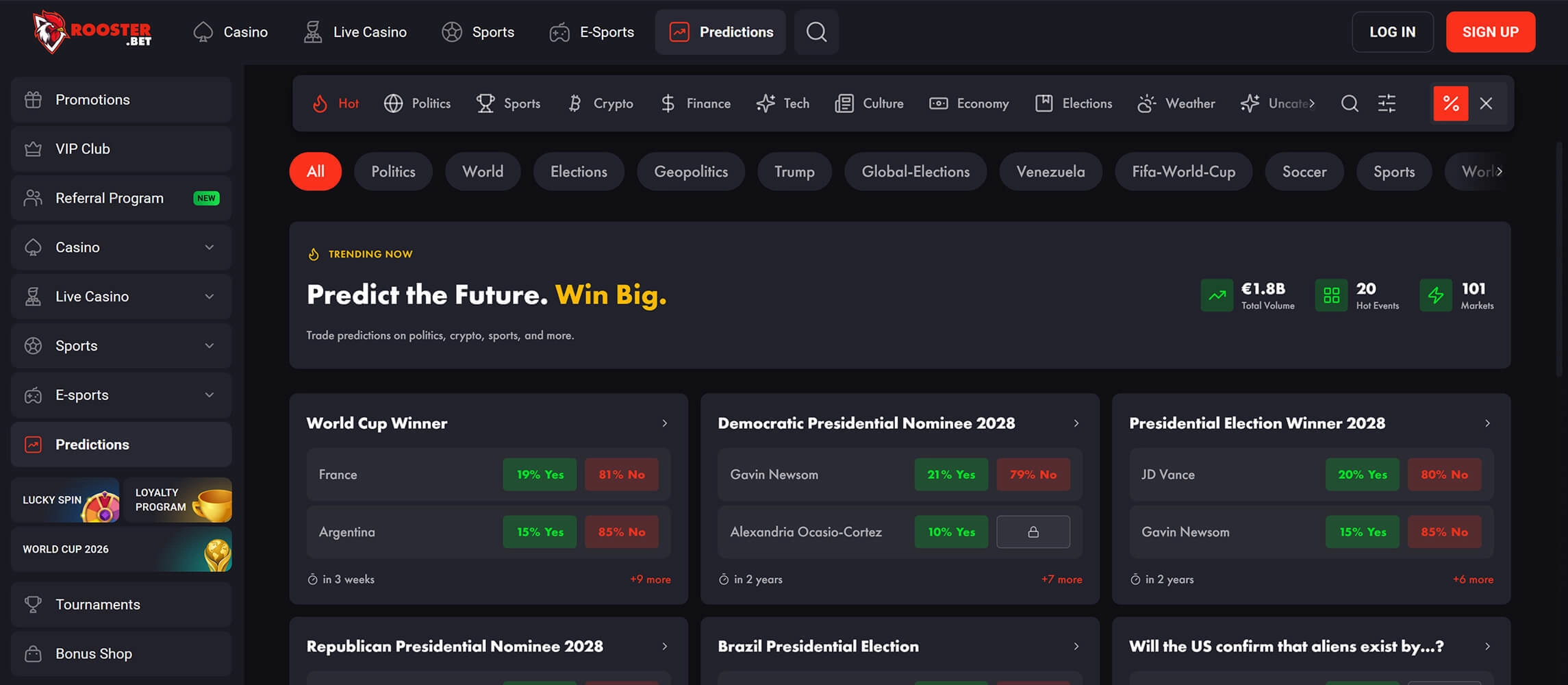
“Prediction markets are no longer a hype but a reality that we felt we needed to jump on immediately. We feel this is a natural extension to our sportsbook, enhancing our fixed-odds offering with markets related to geopolitics, finance & crypto, current affairs, weather, etc., through a simplified UI for our players.
Prediction markets also enable us to target different audiences; not necessarily slots players or sports enthusiasts only, but players with financial backgrounds, anyone interested in current affairs, social media hypes or players who simply want to place a punt on anything really!
The global market volumes clearly show that this category is here to stay, and rather than seeing it as a threat, we adapted the product into what we know best: a simple betting product.”
Prediction markets in Rooster.bet Casino
That positioning matters because it shows prediction markets are not external to iGaming any longer. They are increasingly becoming a part of it.
The generation that isn’t sitting still for a slot
The shift toward prediction markets is not being driven by product innovation alone. It is being driven by behaviour.
Younger players interact with digital systems differently. They are used to fast cycles of input and reward. Social media feeds refresh endlessly. Mobile games reward short bursts of engagement. News, finance, and entertainment all run in one continuous stream.
Traditional casino gameplay, by comparison, can feel static. Even when modernised, it still relies on longer sessions, isolated outcomes, and delayed gratification loops.
Prediction markets match the opposite pattern. They are always active. Always updating and connected to real-world events outside the platform.
This is why Gen Z players are increasingly drawn to them. Not because they reject gambling, but because they expect immediacy and context.
Functionally, prediction markets operate in ways very similar to gambling, as they often produce the same risk-reward behaviour. But psychologically, they feel different because outcomes are tied to real-world narratives rather than isolated game mechanics.
This is where prediction markets gain an advantage, as they are built around events and they do not simulate them.
The regulatory grey zone
Prediction markets fall into a regulatory 'grey zone'. What does this mean for players?
The biggest challenge for prediction markets is regulation.
In the US, platforms like Kalshi currently operate under frameworks for the financial market. But state regulators continue to debate whether they should be treated as gambling products, which leads to ongoing tension.
In the UK and EU, the picture is even less defined. Gambling regulation is strict and established, but prediction markets do not always fit neatly into existing licensing categories. Are they financial instruments, betting products, or something in between?
So, their regulation depends on structure, jurisdiction, and product classification. Some models may fall outside gambling regulation, but this remains a developing legal area rather than a settled one.
Prediction markets aren’t regulated the same way as online casinos either. Casinos operate under dedicated gambling frameworks and they have to comply with strict licensing rules and face higher costs and heavier restrictions.
Prediction markets may operate under different classifications, such as financial, trading, or hybrid oversight, depending on jurisdiction. That imbalance affects competition, product development, and player safety.
The Malta Gaming Authority has already acknowledged this complexity. We talked to them for insights into the issue:
“Prediction markets are not new to the Maltese regulatory framework. The Malta Gaming Authority’s existing framework is technology-neutral and therefore sufficiently flexible to accommodate such offerings. In particular, products of this nature may fall within the scope of either a Type 2 (fixed odds betting) or Type 3 (peer-to-peer/exchange-based betting) licence.
That said, the specific characteristics of certain markets may warrant additional regulatory consideration. The Authority is currently assessing whether particular product features may require a differentiated regulatory approach. In this regard, the MGA remains in ongoing dialogue with relevant stakeholders, including national competent authorities.
The Authority is also currently assessing whether additional guidance may be required to support greater clarity in relation to the regulatory treatment of prediction markets.”
This discussion goes beyond legalities and directly impacts how online gambling products evolve in the next decade.
How iGaming is already responding
Traditional iGaming operators are not ignoring prediction markets. They are already absorbing elements of them into existing products.
Sportsbooks, in particular, have moved toward more dynamic pricing systems. In-play betting mirrors prediction market behaviour, with odds shifting based on live information. The difference is mainly structural rather than experiential.
There is also growing interest in expanding betting categories beyond sports and casino content into broader event-based markets such as politics, weather, crypto, and cultural outcomes. These are the same categories that prediction markets have popularised.
Crypto integration is accelerating this shift. Decentralised crypto casinos act as testing grounds for new betting behaviours, removing friction and allowing rapid experimentation with market formats.
At the same time, established operators are cautious. Regulation, compliance, and responsible gambling obligations mean changes happen incrementally rather than aggressively.
Still, the direction is clear. Especially when we are looking at tried-and-tested models, such as the Betfair brand. iGaming is slowly adopting prediction-style mechanics, even if it does not label them that way yet.
The intersection is already happening today. And at the product level.
Where are prediction markets heading?
Prediction markets and traditional gambling are moving toward each other, but from opposite directions. One is becoming more like entertainment-driven wagering. The other is becoming more like a live financial market.
The result is a blurred middle ground where betting, trading, and speculation overlap.
Does this make prediction markets safer than traditional gambling? Not necessarily. They operate differently, but still involve financial risk, volatility, and behavioural exposure. Safety depends heavily on regulation and platform design rather than category alone.
Gamble RESPONSIBLY. At CasinoWow, we're dedicated to responsible gambling and we provide you with many resources to help you play safe.
For now, they are worth watching carefully from a player protection standpoint as the category grows and regulation catches up.
A prediction market round-up
Prediction markets are quietly changing what “betting” feels like. But at the same time, gambling is borrowing from prediction markets with faster odds, more flexible markets, and more real-world integration.
So, what happens next? Will prediction markets replace casinos and sportsbooks? The most likely outcome is convergence. Casinos and sportsbooks may not disappear. But the boundaries between trading, betting, and speculation are already starting to blur.
It looks like prediction markets will continue to pull attention away from parts of both industries, especially among younger users who never fully adopted traditional formats in the first place.
Which makes one wonder if there's any difference between gambling and prediction markets, as in practice, they increasingly function like it.
That is the real story here. And whether that is labelled gambling, trading, or something new currently depends mostly on which regulator you ask. The most important thing is, though, that this question is still very much open.
Hi, I'm Deni! I'm a research obsessive with a passion for gambling regulations, market trends, and casino news. I dig deep into every topic I cover - so every article, review, or guide I write is built on solid research and real detail.
We use cookies to improve your user experience. By continuing to use this site, you are agreeing to our use of cookies as described in our Cookie Policy.
Subscribe for Exclusive Offers!
Keep in mind that you can also share our articles and reviews on social media!
















 Casino Reviews
 Free Slots
 No Deposit Bonus
 Crypto Casinos
 Bonuses
 WOW Awards
 Casino Jokes
 Big Wins
 Casinos by Country




.png)








.webp "Responsible Gambling & Play Safe")



















 Share on Facebook
 Share on X
 Share on Instagram